
To drive more clicks and interactions, understanding what an SEO Title is and how to create an effective meta title is essential. This critical SEO element helps your website attract users and improve its ranking. Let’s dive into proven strategies with Dali Agency to elevate your website’s performance in search results!
What is an SEO title?
An SEO Title, also known as a meta title or title tag, is a concise text, typically under 60 characters, displayed in search results and browser tabs. It summarizes a webpage’s main content, guiding both users and search engines to understand its topic. For instance, searching for “professional SEO services” might show a title like: “Professional SEO Services – Boost Your Site with Dali Agency.”
More than just a headline, the SEO Title is a key component of on-page SEO. It provides Google with direct information to categorize content and assess its relevance to user queries. A well-crafted title tag stands out in SERPs and drives significant traffic to your website.
How to write a meta title for optimal SEO
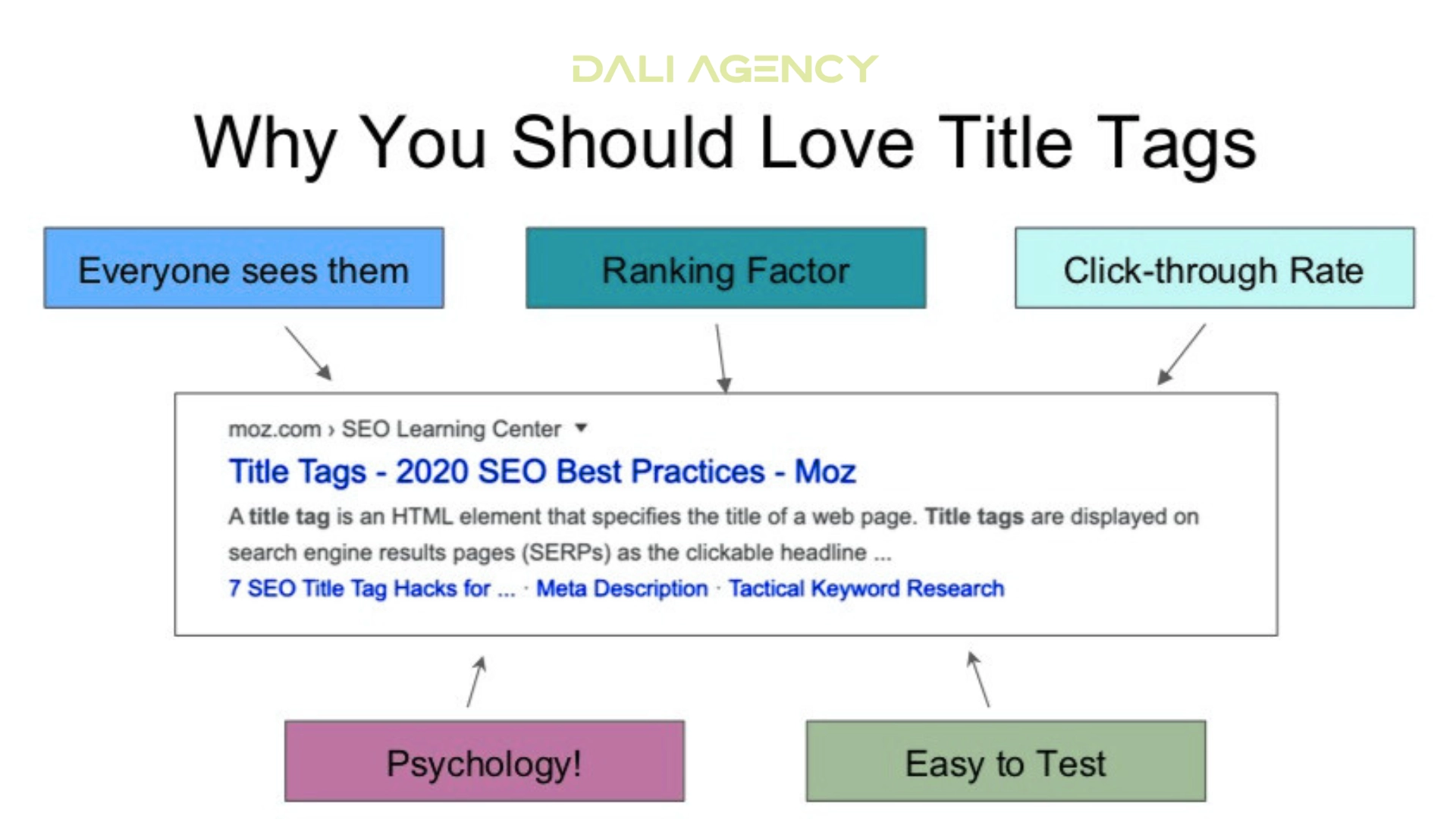
The title tag is a vital part of your website’s code, serving as a bridge to connect with search engines and users. Mastering the art of writing an effective SEO Title requires understanding the factors that enhance a page’s visibility.
1. Place the primary keyword at the start
To optimize for SEO, the primary keyword, such as “SEO Title,” should appear at the beginning of the title. This helps Google quickly identify the page’s main topic and increases its chances of ranking higher when users search for that keyword.
Positioning the keyword at the start also allows users to immediately recognize the page’s core content and determine if it matches their search intent. However, prioritizing the keyword can sometimes make the title feel less natural or engaging. Striking a balance between keyword optimization and creating an appealing, user-friendly title is key to attracting both search engines and readers.
2. Keep the meta title under 60 characters
Google typically displays 60-70 characters for an SEO Title. If the title is too long, it may get truncated, losing critical information. Use tools like Yoast SEO or test directly in a browser to ensure the title length is appropriate.
3. Incorporate related keywords and LSI
In addition to the primary keyword “SEO Title,” include related keywords such as “Meta Title,” “SEO optimization,” or “writing website titles.” Latent Semantic Indexing (LSI) keywords help Google better understand the page’s content, improving its relevance.
4. Create engaging, natural, and action-oriented titles
A title tag must be technically sound and captivating. Use words like “guide,” “tips,” “best,” or “free” to spark curiosity. An effective SEO Title blends the keyword with a clear, engaging structure to drive clicks.
5. Ensure uniqueness for each page
Every page on your website should have a unique Search Engine Optimization Title to avoid duplication. Duplicate titles can confuse Google, leading to lower rankings. Dali Agency meticulously checks to ensure each client’s page has a distinct Meta Title.
Mistakes to avoid when writing a meta title
Crafting an effective SEO Title requires avoiding common pitfalls that can harm your rankings and user experience.
Overusing the keyword
Excessively repeating “SEO Title” in the title can be flagged as spam by Google, hurting rankings and making the title seem unnatural. Use the keyword strategically, complemented by related terms for balance.
Exceeding the character limit
Titles longer than 60 characters risk being cut off in SERPs, omitting critical details. Verify the length using SEO tools or by testing directly in search results.
Misleading title content
A Meta Title must accurately reflect the page’s content. If it promises something the page doesn’t deliver, users will leave quickly, increasing bounce rates and negatively affecting SEO.
Overusing special characters
Excessive special characters like “!!!,” “***,” or too many emojis can make a title appear unprofessional. However, hyphens (-) or colons (:) can enhance clarity when used sparingly.
How to measure the effectiveness of your title tag
After creating a Meta Title, evaluate its performance to make data-driven adjustments. Dali Agency uses the following methods to optimize title effectiveness:
Use SEO tools for analysis
Tools like Google Search Console, Ahrefs, or SEMrush help track click-through rates (CTR) and rankings for your SEO Title, providing insights into its performance.
Check display in SERPs
Search for your primary keyword on Google to see how the title appears. If it’s truncated, revise it to fit within the character limit.
Analyze user behavior
Monitor bounce rates and average time on page to assess whether your Meta Title attracts the right audience and aligns with the page’s content.
Conclusion
The SEO Title is a cornerstone of any Search Engine Optimizationstrategy, acting as a bridge between your website and its audience. A well-optimized Meta Title boosts rankings, increases click-through rates, and strengthens brand identity. By starting with the keyword, keeping the length appropriate, and avoiding common errors, you can craft a compelling title. Dali Agency, with its SEO expertise, is ready to help you optimize your meta titles for maximum impact.
