

What is Google Ads? With the continuous development of the Internet and the extensive reach of the Google network, users’ demand for information is increasing, and businesses have begun to compete for the number of impressions and brand recognition. Google Ads is a powerful online advertising platform today, which plays a significant role in determining the ranking of business ads.
Let’s explore this topic further with Dali Agency in the article below.
What is Google Ads?
Google Ads is an online advertising platform developed by Google. Businesses’ ads can appear in Google search results, on partner websites within the Google Display Network, or through formats like Search Ads, Display Ads, Video Ads, or Shopping Ads.
Helps businesses target users precisely based on keywords and demographics. Moreover, it optimizes costs and increases the chances of reaching potential customers.
How does Google Ads work?
In order to quickly attract viewers/clicks on ads, businesses need to understand how Google Ads works.
Google Ads operates on an auction system
Specifically, when a user searches for a specific keyword, Google’s system conducts an auction between businesses that want to advertise for that keyword, with the highest bid. However, a higher bid does not always guarantee priority.
Google uses Quality score to determine which ads appear first and in which position, based on three factors:
- Ad relevance: Is the ad relevant to the keyword the user searched for?
- Landing page experience: Does the landing page the user clicks on provide quality content and meet their needs?
- Quality score: The overall score based on factors related to the ad and the landing page.
This system ensures fairness in determining where a business’s ad will be positioned.
Measuring CPC
CPC (Cost Per Click) is the cost a business has to pay every time a user clicks on its ad.
For a successful ad campaign, it’s not only about having a high bid but also ensuring that the ad is relevant to the user’s needs and provides value.
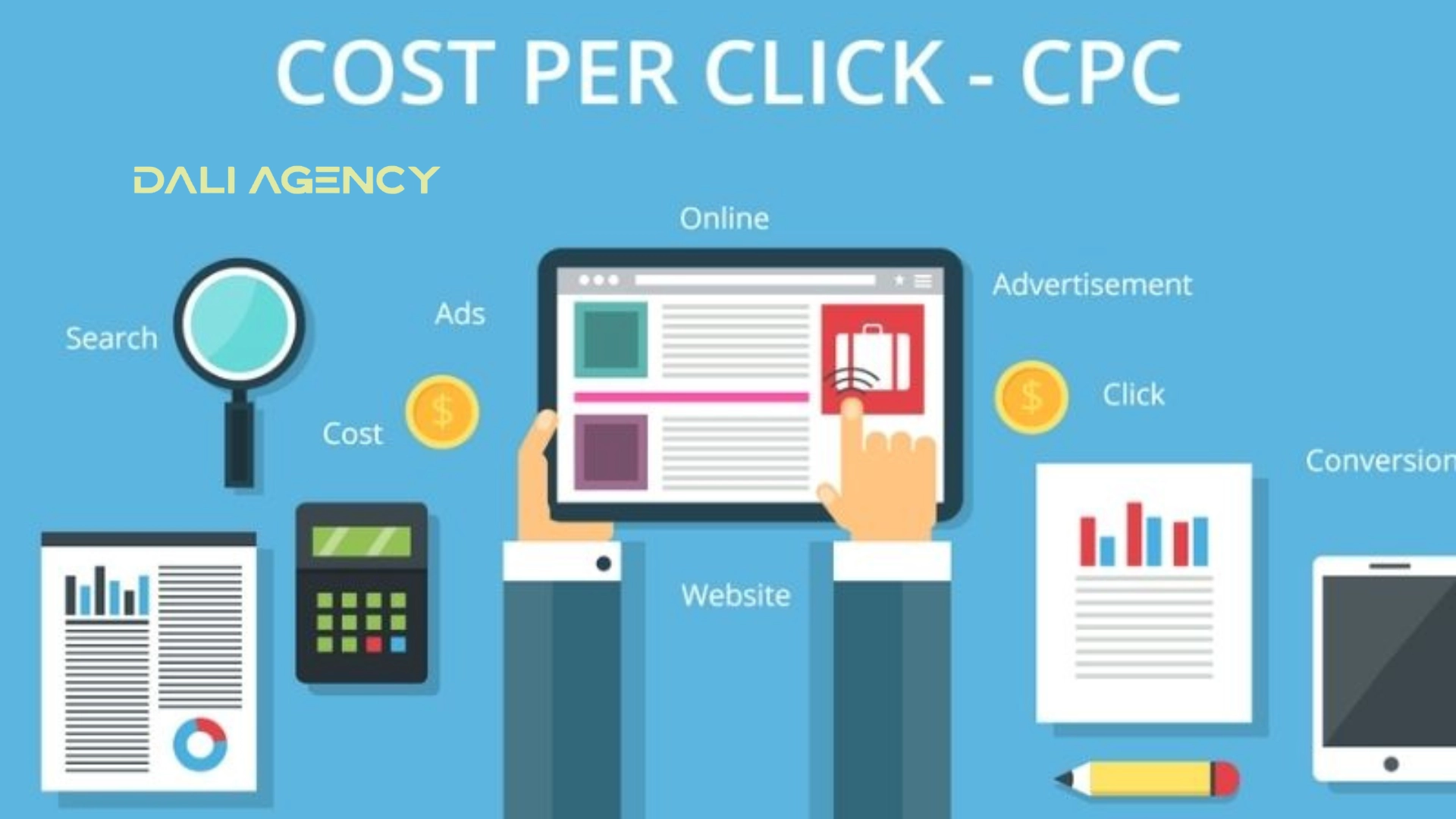
Calculates CPC based on two factors:
- Maximum Bid (Max CPC): The highest amount a business is willing to pay for each click on its ad.
- Quality Score: The higher the Quality Score, the lower the CPC, as Google considers the ad to be useful to the user.
CPC is measured by dividing the total ad spend by the number of clicks.
CPC measurement formula
CPC = Total ad spend / Number of clicks
In summary:
Google Ads operates on an auction model, which considers not only the bid price but also the relevance and quality of the ad.
CPC is the cost paid each time a user clicks on the ad, and it depends on both the maximum bid and the ad’s Quality Score.
Budget for Google Ads
The Google Ads budget can be adjusted flexibly according to needs and is allocated for the entire campaign.
After setting the budget, Google will calculate and distribute the ads in a way that aligns with the maximum cost specified.
There are three common pricing methods when running ads:
- CPC (Cost per click): Pay when a user clicks on the ad.
- CPM (Cost per mille): Pay based on the number of ad impressions (1,000 impressions).
- CPA (Cost per acquisition): Pay when a user takes a specific action, such as making a purchase or filling out information.
Businesses should allocate their budget wisely, understand the pricing model, and choose the method that aligns with the campaign goals. These are crucial factors that determine the effectiveness of the ads.
Key metrics in Google Ads
When running Google Ads, businesses need to monitor and evaluate several important campaign metrics:
CTR (Click-through rate)
This is the percentage ratio between the number of clicks on an ad and the number of impressions. A high CTR indicates that the ad is appealing and attracts users.
CPC (Cost per click)
This is the cost per click. As mentioned earlier, this metric shows how much a business is paying for each click from a user.
Quality Score
Google Ads evaluates based on the relevance and landing page experience. A high Quality Score helps businesses reduce costs and achieve a better ad position.
Conversion rate
This is the percentage ratio between the number of conversions (e.g., purchases, form submissions) and the number of clicks on the ad.
CPA (Cost per acquisition)
This is the cost per conversion. CPA measures the cost needed to acquire a customer who takes a desired action, such as making a purchase, registering, downloading an app, or filling out a form.
CPA is an extremely important metric. It helps measure the effectiveness of the ad campaign based on the ultimate goal: conversion.
While CPC measures the cost per click and CPM is based on impressions, CPA evaluates the true cost of acquiring a customer.
Monitoring and analyzing these metrics will help businesses understand the effectiveness of their campaign and make necessary adjustments.
Advantages and disadvantages of running Google Ads
Advantages
- Precise targeting: Allows targeting based on various criteria such as keywords, location, device, and user behavior.
- Flexible budget control: The budget can be easily adjusted, and you only pay for actual results.
- High measurability: Offers a wide range of analysis and reporting tools, making it easy to evaluate performance and optimize campaigns.
- Instant reach: Unlike SEO, Google Ads delivers quick results, providing immediate access to customers.
Disadvantages
- High competition: For competitive industries, CPC can be very high, requiring a larger budget to maintain.
- Requires in-depth knowledge: To run an effective campaign, one needs to fully understand how it works and continuously monitor and optimize it.
- Risk of wasting budget: Without careful management, businesses can easily overspend without achieving the desired results.
Optimization for Google Ads
Optimizing Google Ads not only helps reduce costs but also increases campaign effectiveness. Here are some ways businesses should focus on optimizing their ads:
Optimize keywords
Use the Google Keyword Planner tool to research and choose keywords with moderate competition but still high search volume. Additionally, using negative keywords helps prevent ads from showing up for irrelevant searches.
Improve quality score
Ensure that the ad is relevant to the user’s search intent, the landing page is user-friendly, and it provides a good experience.
Optimize ad copy
Experiment with different ad copies to see which one has the highest CTR and conversion rate.
Monitor and adjust the budget
Regularly track metrics such as CTR, CPC, and Conversion Rate to adjust the budget for the keywords and campaigns that deliver the best results.
Use ad extensions
Ad extensions like site links, phone numbers, or ratings can increase the ad’s appeal and boost the click-through rate.
Conclusion
Google Ads is a powerful tool for businesses looking to reach customers quickly and efficiently. However, to achieve success, businesses need a clear strategy, continuous optimization, and tracking of key metrics. Investing in Google Ads is not just about the budget but also about understanding your customers, the market, and optimizing every element of the campaign.
When implemented correctly, Google Ads can be a highly profitable marketing channel that helps businesses grow sustainably. If you want to learn more or need assistance in running your Google Ads campaign, feel free to contact Dali Agency for expert advice and support.
